
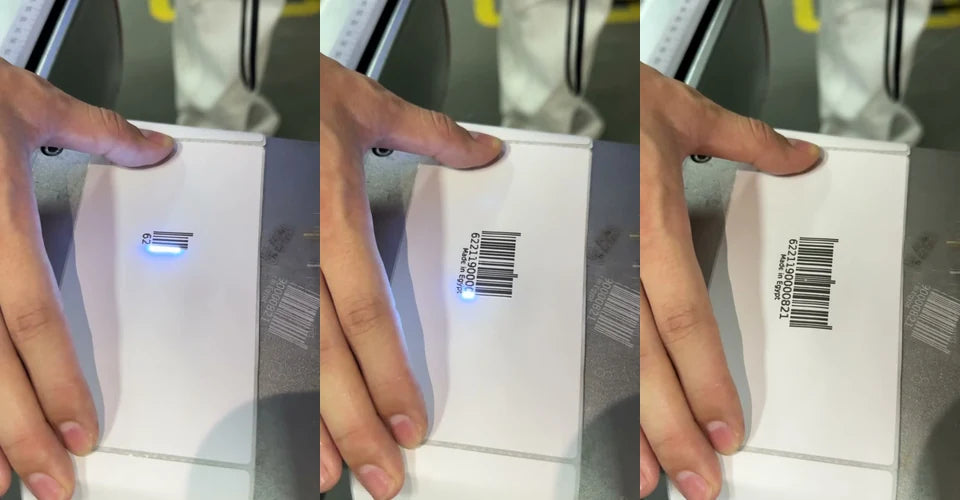
A useful trial should answer whether a proposed configuration can produce the mark you need on the product you actually make. A photo of a similar product or a single power value cannot answer that question.
Prepare a representative sample
- Supply the actual product or packaging, including coating and printed finish.
- Describe the material and any variations in color, formulation or surface treatment.
- Provide several representative samples if the finished surface varies between batches.
Send the complete marking requirement
- The actual text or code content, including variable fields.
- The required mark dimensions and the usable marking area.
- A drawing or photo showing the desired position and orientation.
- Readability, contrast and surface acceptance criteria.
Describe how the product moves
State whether marking is stationary, indexed or performed on a moving conveyor. Include line speed, product spacing, orientation and any fixture, paging or vision-positioning requirements.
Ask for a traceable result
Request the machine model, laser source, optics and trial conditions with the result. Review both the marking process and a close-up of the finished sample. A video without a readable model plate should not be treated as proof of a specific power or throughput.
Agree what happens after the trial
Confirm the final configuration, installation scope, operator training, acceptance process and support arrangements in the quotation. A successful material trial and a completed production-line integration are separate milestones.
Get a configuration for your actual product
Send the material, a sample photo, the required code and your production conditions. Ask for a marking trial and a written configuration before ordering.
Request a sample review