
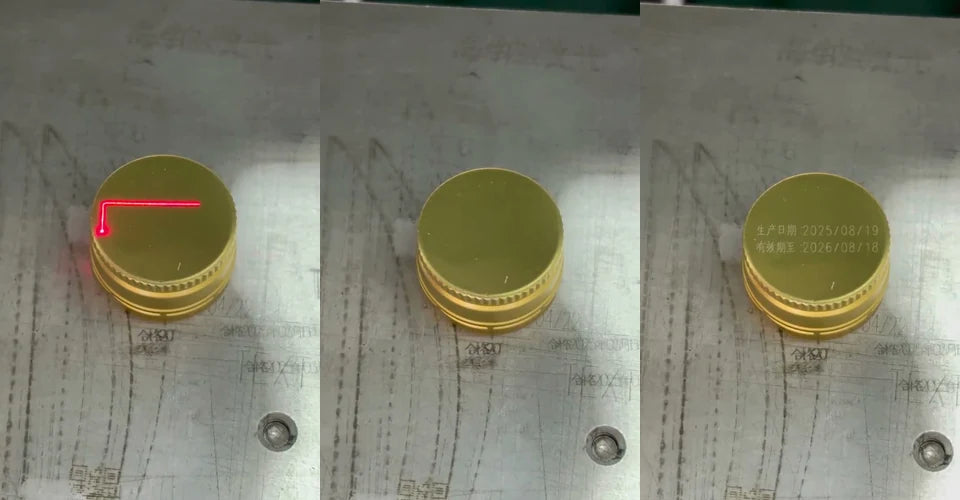
The first question is what must be marked, not which wattage is largest. The supplied HAINA catalogue lists fiber, CO₂ and UV families with different wavelengths and configuration options. Use them to shortlist a trial, then choose from the actual marking result.
1. Identify the surface you need to mark
Record the substrate, resin or coating, color and finish. Two packages with the same appearance may behave differently. Include the required contrast and whether any visible surface change is acceptable.
2. Compare the catalogue families
| Fiber / NF catalogue | 1064 nm; 20 / 30 / 50 / 100 W series options; metals and selected plastics. |
|---|---|
| CO₂ / HC catalogue | 10.6 μm; 30 / 60 / 100 W series options; selected packaging, paperboard, glass and wood. |
| UV / HN catalogue | 355 nm; 5 / 10 / 15 W series options; fine marking on selected plastics and printed packaging. |
3. Evaluate the complete configuration
Laser source, optics, marking field, cooling and handling all belong in the comparison. Catalogue power options do not establish a universal maximum production speed. Your code and material must be assessed within the available marking window.
4. Separate catalogue names from a specific offer
NF, HC and HN are the catalogue references used here. Do not assume another commercial series name is equivalent. Ask the supplier to identify the exact model, source, optics and options in the quotation and trial record.
5. Request comparable samples
Use the same product, code dimensions and acceptance criteria when comparing proposals. Ask for close-up images and a video of the actual trial, then review readability, contrast, position and surface condition.
Get a configuration for your actual product
Send the material, a sample photo, the required code and your production conditions. Ask for a marking trial and a written configuration before ordering.
Request a sample review